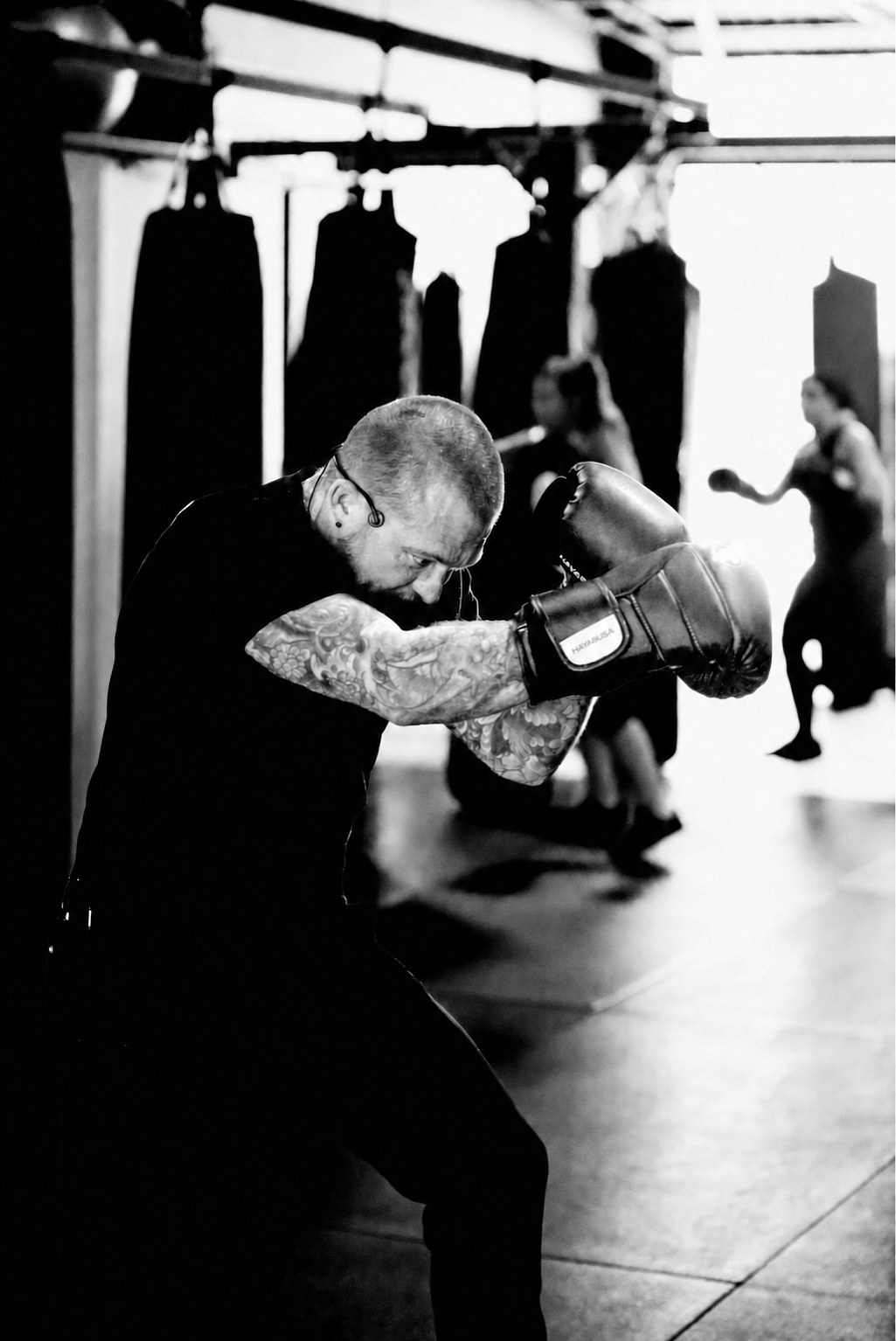
A student in my class last week had every ingredient people assume you need to break a board. Power. Confidence. Speed. The board stayed in one piece anyway.
The reason had nothing to do with heart or effort. His foot was two inches off center. That's it. Board breaking isn't about strength, and it isn't about summoning some invisible force through your fist. It's about precision — and precision is just math, applied by a human body.
Every board break comes down to four things you can actually measure. Alignment: your striking surface — heel, palm, knuckle — has to line up with the center of the board, or your power gets redirected into the holder's hands instead of through the wood. Contact point: for a back kick, you strike with the heel, not the ball of the foot, not the flat of the foot. Bone concentrated into a small area beats wood every time, but only if you're hitting with the right part of that bone.
Distance is the third variable. You need to be positioned so your kick reaches full extension right at the board — not before it, not past it. Too close and you're pushing. Too far and you're reaching. Both waste energy you already generated. And fourth: follow-through. You're not aiming at the board's surface, you're aiming at the space six inches behind it. The board is just the thing standing in the way of where your kick is actually going.
Line up all four and the board breaks close to every time. Miss on just one and it doesn't matter how hard you kicked — the math didn't work, so the wood wins.
I tell students constantly: it lines up and it works when you do the math right. That's not a martial arts platitude, it's a literal description of how most things in life behave. A job interview. A business plan. A relationship conversation you've been avoiding. When the real variables line up — preparation, timing, precision, follow-through — the outcome stops being a mystery. When they don't, you can bring all the motivation in the world and still come up short. The board doesn't respond to how badly you want it to break. Neither does most of life.
We adjust. Nobody quits over a missed break in my class. We check the alignment. We check the distance. We check exactly where contact happened. Then we try again with actual information instead of just trying harder.
That student who missed? He broke the board on his second attempt — not because he suddenly got stronger in thirty seconds, but because he moved his foot two inches. That's the real lesson. Not the break itself. The adjustment that made it possible.
We train board breaking the same way we train everything else at the dojo: as something you can measure, correct, and repeat — not something you hope for. Students who can break boards consistently know exactly why it worked, which means they can teach it to the next person standing in line. That's what mastery actually looks like. Repeatable. Teachable. Measurable. Math, not magic.