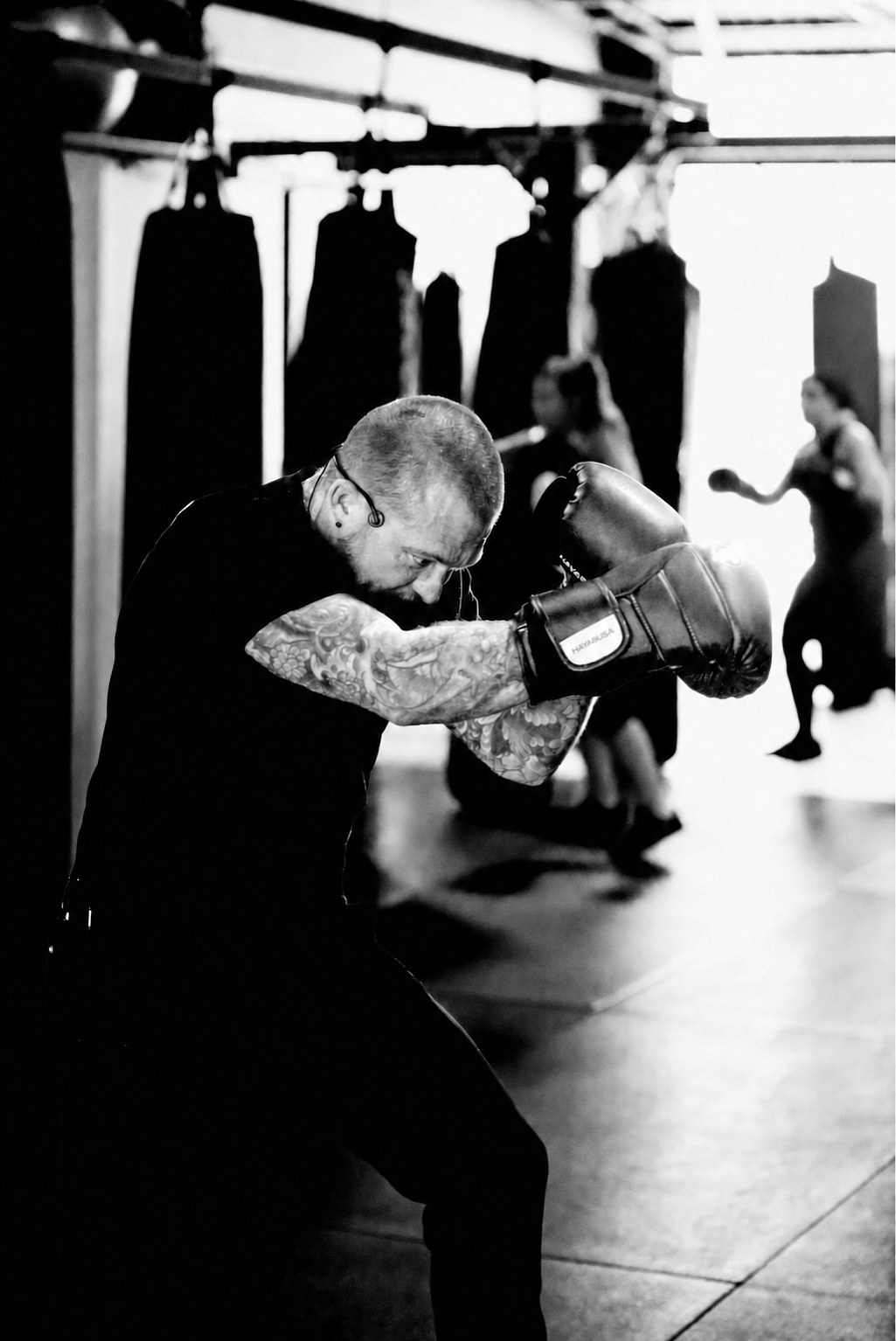
Most people punch with their arm. They extend it, make contact, pull it back — and that's roughly sixty percent of what that punch could actually deliver. The other forty percent comes from a single adjustment that takes about three seconds to learn and years to actually master: turn your shoulder until it touches your chin.
When you throw a rear-hand straight punch, most of the real power comes from hip rotation, not arm extension. But the signal that tells your hips to complete that rotation is your shoulder. If your shoulder stops six inches short of your chin, your hips stop rotating too soon along with it — the punch still lands, but without the full kinetic chain behind it.
Drive the shoulder all the way forward until it makes contact with your chin, and three things happen at once: your reach extends by roughly six inches, your hips complete their full rotation, and your body weight transfers forward behind the fist instead of staying parked on your back foot. Same arm. Same fist. Meaningfully more power, just from finishing a motion most people cut short.
I teach this with an image I come back to often. A tree isn't just a trunk with branches — it has roots running deep underground that feed the trunk, which supports the branches, which eventually bear fruit. Your legs and hips are the roots. Your torso is the trunk. Your arm is the branch. The punch is the fruit. Try to grow fruit without roots and you get a weak, disconnected punch no matter how hard you try. Drive from the ground up — feet, knees, hips, core, shoulder, fist — and the punch arrives carrying the weight of the whole tree behind it. Shoulder to chin is the cue that makes sure the whole tree is actually working.
Stand in your fighting stance. Throw a slow cross and stop the moment your arm is fully extended. Check where your shoulder ended up — if it's pointing off at an angle instead of straight at your chin, you left power sitting on the table. Reset and try again, this time driving the shoulder all the way forward until it touches your chin. You'll feel the difference in your hip engagement immediately.
Do that twenty times, slow, then start speeding it up. Within about a week of deliberate practice, that full rotation becomes automatic instead of something you have to think about mid-punch.
This is the kind of detail that separates someone who does martial arts from someone who understands it. Everybody learns to throw a punch. Not everyone learns to throw it with their whole body behind it — and this cue applies just as much to hooks and uppercuts as it does to the cross.
If you want to work through mechanics like this hands-on, that's exactly the kind of detail we drill in class.